

6 Grounding Techniques to Support Your Mental Health
Mental health is health, and this month, Colorado Health Network has been sharing simple, evidence-informed tools to help you feel more grounded, calm, and present.
Throughout May’s Mental Health Awareness Month, our Mental Health Mondays series covered practical grounding techniques that anyone can use, no special equipment, no appointments, no experience required. Whether you’re living with HIV, navigating a stressful season, or just looking for tools to support your everyday wellbeing, these practices are for you.
What Is Grounding, and Why Does It Matter?
When stress, anxiety, or overwhelming emotions hit, our nervous system can shift into “fight, flight, or freeze” mode. Grounding techniques are tools that help interrupt that response and activate the parasympathetic nervous system, the part of the body responsible for calming, regulating, and restoring a sense of safety.
The six techniques below draw on your senses, your breath, your body, and your mind to bring you back to the present moment.
1. The 5-4-3-2-1 Technique
This simple sensory exercise anchors you in the here and now by inviting you to notice what’s already around you. This technique dates back to the mid-late 1900s and is credited to psychotherapist Betty Alice Erickson.
5 things you can see | Look for small details: a pattern on the ceiling, the way light reflects off a surface, or an object you’ve never really noticed before.
4 things you can feel | The sensation of clothing on your skin, the warmth of sunlight, the texture of the chair beneath you.
3 things you can hear | Tune into sounds your mind usually filters out: a ticking clock, distant traffic, wind through the trees.
2 things you can smell | Air freshener, freshly mowed grass, a nearby flower or candle.
1 thing you can taste | Keep gum or a small snack on hand for this one. Take a moment to really notice the flavor.
Working through your senses one by one helps redirect your brain’s attention away from stress and toward the present moment.
2. Deep Breathing
Covered in “Breathing Practices for Stress and Anxiety Reduction: Conceptual Framework of Implementation Guidelines Based on a Systematic Review of the Published Literature”, published in Brain Sciences, controlled breathing is one of the most accessible grounding tools we have, and it works quickly.
Exercise 1: Belly Breathing | Lie on your belly on the floor and breathe deeply into your stomach. This position activates the vagus nerve, slows the heart rate, and sends a signal of safety to your nervous system.

Exercise 2: 4-4-6 Breathing | Inhale slowly through your nose for 4 seconds. Hold that breath for 4 seconds. Exhale slowly through your mouth for 6 seconds. Here’s a tip, pucker your lips as if you’re blowing through a straw. This naturally slows your exhalation and deepens the calming effect.
You can do either of these anywhere, at home, at work, in the car, in a waiting room. No one even has to know you’re doing it.
3. Move Your Body
Movement is medicine, and it doesn’t have to be a workout.
Stretching, going for a short walk, rolling out a yoga mat, dancing in your kitchen, whatever kind of movement feels right for you counts. When you move your body, you:
- Decrease muscle tension
- Activate the frontal lobe (responsible for clear thinking and decision-making)
- Quiet the amygdala, the brain’s reactive stress center
- Boost natural anti-anxiety neurochemicals like serotonin and GABA
The goal isn’t to hit a step count or break a sweat. The goal is to shift your body out of stillness and into a state where your nervous system can regulate itself.
4. Walk in Nature
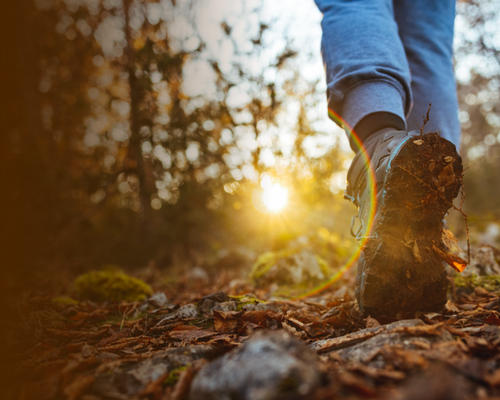
If you can take your movement outside, even better.
Walking outdoors, noticing the trees, the plants, and the feeling of sunlight on your skin, has measurable effects on the body:
- It lowers cortisol, the hormone associated with stress
- It helps regulate the sympathetic nervous system, which goes into overdrive during fight, flight, or freeze
You don’t need a hiking trail or a state park. A neighborhood sidewalk, a parking lot with a few trees, or a bench in a small courtyard all count. The point is to get outside and pay attention to what’s around you.
5. Tip the Temperature
This technique comes from Dialectical Behavioral Therapy (DBT) and uses cold temperature to trigger what’s called the “dive response”, a physiological reflex that slows the heart rate and activates the parasympathetic nervous system almost immediately.
How to try it:
- Hold your breath and submerge your face in a bowl of cold water, or press a cold pack (or a zip-lock bag of cold water) over your eyes and cheeks.
- Hold for 30 seconds.
- Keep the water above 50°F.
This is especially useful during moments of intense emotional distress, when other techniques feel too slow or too subtle. It’s fast, discreet, and genuinely effective.

6. Mental Exercises
Sometimes grounding happens entirely in the mind. These quick exercises work by giving your brain something concrete and engaging to focus on — which interrupts the cycle of anxious or overwhelming thoughts.
Try one of these anywhere, anytime:
- Name all the objects you can see right now
- Describe the steps involved in something you know how to do well
- Count backward from 100 by 7
- Pick up a nearby object and describe it in detail: its color, texture, weight, scent, and any other qualities you notice
- “Draw” an object in your mind or trace its shape in the air with your finger
These exercises are especially useful in situations where other grounding techniques aren’t possible, like during a meeting, on public transit, or in any environment where you need something quiet and internal.
You Don’t Have to Wait for a Crisis
Grounding techniques work best when they’re practiced regularly, not just reserved for moments of acute stress. Building one or two of these into your daily routine can strengthen your nervous system’s overall resilience over time.
At Colorado Health Network, we believe that mental health is an essential part of whole-person care. For the communities we serve, including people living with HIV, emotional and psychological wellbeing matters just as much as physical health.
If you or someone you care about is looking for mental health support, our team is here. We offer integrated behavioral health services across Colorado.